Welcome To St. Nicholas Cathedral

The history of the Cathedral located in Los Angeles, California, is truly a story of people of vision, courage, dedication, leadership and religious conviction. It is the story of the needs of many Orthodox families who had settled in the greater Los Angeles area since the turn of the twentieth century. It is a story of those who had devoted their lives to the service of our community, of leaders who are no longer with us but who shall always remain dear in our hearts because of their wisdom, love and accomplishments. Their legacy continues today.

image

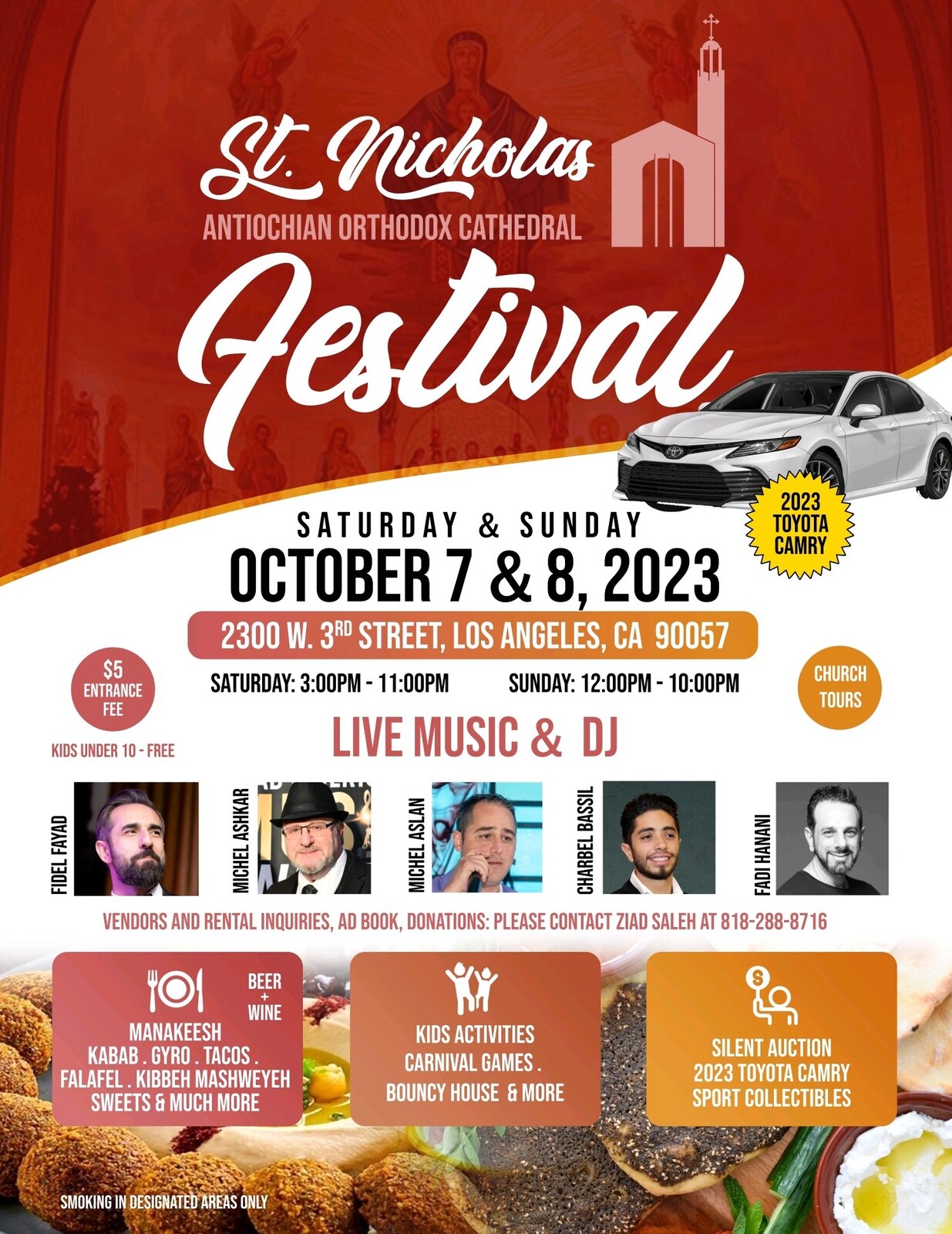
We have vendor and sponsorship opportunities. Let Cathedral members and all our Festival guests (about 2000) know about services you can provide them, as you will be recognized in our publicity, in a brochure and on our website. Contact Ziad Saleh at Zee.Saleh@CaMoves.com.

Typical Service Schedule
Sunday
7:45am - Divine Liturgy in Spanish
9:15am - Orthros (Matins)
10:30am - Divine Liturgy
  
Saturday
6:00pm - Great Vespers
  
Eve of Feast
6:30pm - Vesperal Divine Liturgy of the Feast

For some feasts, we serve a Vesperal Divine Liturgy on the eve of the feast.  Check our Cathedral Calendar for details.

  
Feast
9:30am - Feast Day Divine Liturgy

In most cases, we will serve Orthros along with Divine Liturgy on the morning of feast days.  Check the Cathedral calendar for current schedule and start times.

  
FALL ADULT STUDY CLASSES

Getting back into the swing, after summer, we have several offerings from which adults of all ages may choose.

Wednesdays, Vespers at 6:30 pm, Dinner at 7:00 pm, Classes 7:30 to 9:00 pm – In-person and Online – Starting Sep. 9

  1. to Orthodoxy: “Search the Scriptures – What We Believe and Do”
  2. Discover the Divine Liturgy in Arabic: “A Spiritual Journey into the Meaning of the Orthodox Divine Liturgy” اكتشف القداس الإلهي: رحلة روحية في معنى الليتورجيا الأرثوذكسية

Thursdays, 7:00 to 8:30 pm – In-person – Starting Sep. 10

  1. New Testament Greek: Bringing the Gospel of John to Life in the Original Language
  2. Liturgical Arabic: Learn Arabic by learning the Liturgy in Arabic.
image


image
Thursdays, 7:00 to 8:30 pm

Learn a Language by the Inductive Method, Like How Children Learn to Speak 
In-person – Starting Sep. 10

  • New Testament Greek: Bringing the Gospel of John to Life in the Original Language. 

    It has been said, "You cannot interpret the Bible or make theology on the basis of a translation." While it's ok to read for content and inspiration in whatever language you know best, you need to use the original language to understand more completely. This is the original language of the New Testament, of parts of the Old Testament, of the Liturgy and the vast majority of our Church Fathers. It is NOT modern Greek.


  • Liturgical Arabic: Learn Arabic through the Liturgy.

    This course will introduce students to Arabic through the prayers, hymns, and responses of the Orthodox Church. Designed to accommodate both complete beginners and those seeking to build upon existing familiarity, students will learn to read Arabic script and participate in selected prayers and hymns in Arabic.
    Please click here to register online
Today's Commemorations
The Elevation of the Venerable and Life-Giving Cross, Commemoration of the 6th Ecumenical Council
Today's Scripture Readings
ST. PAUL'S FIRST LETTER TO THE CORINTHIANS 1:18-24
Brethren, the word of the cross is folly to those who are perishing, but to us who are being saved it is the power of God. For it is written, "I will destroy the wisdom of the wise, and the cleverness of the clever I will thwart." Where is the wise man? Where is the scribe? Where is the debater of this age? Has not God made foolish the wisdom of the world? For since, in the wisdom of God, the world did not know God through wisdom, it pleased God through the folly of what we preach to save those who believe. For Jews demand signs and Greeks seek wisdom, but we preach Christ crucified, a stumbling block to Jews and folly to Gentiles, but to those who are called, both Jews and Greeks, Christ the power of God and the wisdom of God.
JOHN 19:6-11, 13-20, 25-28, 30
At that time, when the chief priests and the officers saw him, they cried out, "Crucify him, crucify him!" Pilate said to them, "Take him yourselves and crucify him, for I find no crime in him." The Jews answered him, "We have a law, and by that law he ought to die, because he has made himself the Son of God. When Pilate heard these words, he was the more afraid; he entered the praetorium again and said to Jesus, "Where are you from?" But Jesus gave no answer. Pilate therefore said to him, "You will not speak to me? Do you not know that I have power to release you, and power to crucify you?" Jesus answered him, "You would have no power over me unless it had been given you from above; therefore he who delivered me to you has the greater sin." When Pilate heard these words, he brought Jesus out and sat down on the judgment seat at a place called the Pavement, and in Hebrew, Gabbatha. Now it was the day of Preparation of the Passover; it was about the sixth hour. He said to the Jews, "Behold your King!" They cried out, "Away with him, away with him, crucify him!" Pilate said to them, "Shall I crucify your King?" The chief priests answered, "We have no king but Caesar." Then he handed him over to them to be crucified. So they took Jesus, and he went out, bearing his own cross, to the place called the place of a skull, which is called in Hebrew Golgotha. There they crucified him, and with him two others, one on either side, and Jesus between them. Pilate also wrote a title and put it on the cross; it read, "Jesus of Nazareth, the King of the Jews." Many of the Jews read this title, for the place where Jesus was crucified was near the city; and it was written in Hebrew, in Latin, and in Greek. But standing by the cross of Jesus were his mother, and his mother's sister, Mary the wife of Clopas, and Mary Magdalene. When Jesus saw his mother, and the disciple whom he loved standing near, he said to his mother, "Woman, behold your son!" Then he said to the disciple, "Behold your mother!" And from that hour the disciple took her to his own home. Then when Jesus had received the vinegar, he said, "It is finished"; and he bowed his head and gave up his spirit.
Today's Thought

Having stretched out His hands upon the Cross, the Savior with them, as it were, embraced the world, and by His blood shed on it, like a king with red ink, He signed the forgiveness of the human race. - St. John Maximovitch

St Nicholas Orthodox Cathedral
2300 W 3rd Street
Los Angeles, CA  90057

Cathedral@StNicholasLA.COM
(213) 382-6269

To join our mailing list or to leave us an email, please use our contacts page. We look forward to hearing from you.